True Names
Naming things is the hardest part of programming. Egypt knew it, the fae knew it, Genesis knew it. To hold a thing’s true name is to hold the thing.
“There are only two hard things in computer science: cache invalidation and naming things.”
That’s Phil Karlton, a Netscape engineer, whose son still keeps the line on a page called karlton.org.
Cache invalidation is hard the way arithmetic is hard. You can grind it until it gives. Naming things is hard a different way. It’s hard because a name is a claim about what a thing actually is, and usually you don’t know yet.
So I went looking for why names carry so much weight. The programmers are late to this. I followed the idea back as far as it goes and then walked it forward, and it never once breaks. Three thousand years of people telling the same secret: get the name right and you get the thing.
The rule
Start at the literal beginning. The oldest creation poem we have, the Babylonian Enuma Elish, opens on a universe that doesn’t exist yet, and the way it tells you so is that nothing has been named. To be is to be named. Naming is the first act of making.
Egypt wrote down the dangerous corollary about 3,200 years ago. Ra, the sun god, had a secret name no one knew, and “by the knowledge of his own name did Ra rule.” So Isis built a serpent out of his own spit, let it bite him, and offered the cure on one condition: his true name. He gave her every title he had. None of them worked. Only when he surrendered the real one did the poison leave, and from that hour she was his equal. Whoever holds your true name holds you.
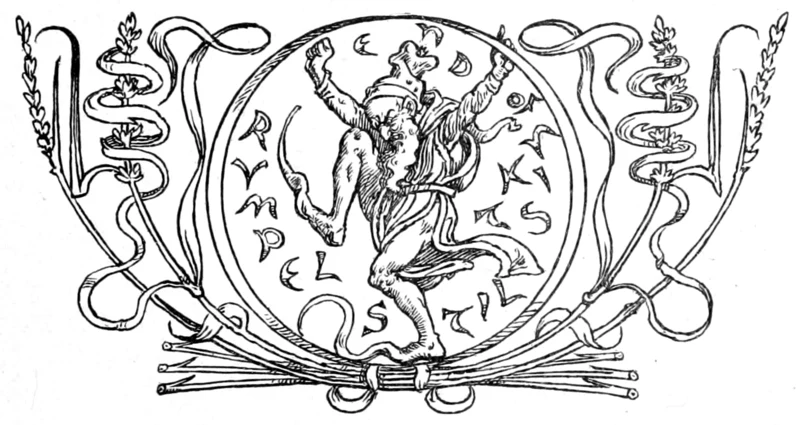
Humans wrote that story everywhere, on every continent, separately. The famous one is Rumpelstiltskin. A goblin spins gold, comes for the queen’s firstborn, and the whole bargain breaks the instant she says his name out loud. Folklorists gave the pattern its own number, tale type 500, “The Name of the Helper,” and it turns up on its own as Tom Tit Tot in England, Whuppity Stoorie in Scotland, Gilitrutt in Iceland, a carpenter and an ogre in Japan. Different languages, no contact, same rule: say the name, break the power.
So people learned not to say it. The English wouldn’t even name the fae. They called them “the Good Folk” and “the Fair Folk,” flattery to dodge summoning the thing you named. A thousand years ago Japan turned the fear into a doctrine and called it kotodama, the spirit that lives in words. Your name carried your soul, so your true name stayed hidden. We still don’t know the real names of the two greatest writers of the Heian court. Murasaki Shikibu and Sei Shōnagon are both pen names, and that was on purpose.
The name was also how you took command of a thing. Old King Solomon, the story goes, ruled the demons by knowing their names, and for the next fifteen hundred years the grimoires copied the trick: page after page of spirits, each with a name and a seal, because to name one was to bind it. The Gospels run the same play. When Jesus meets the man in the tombs, the first thing he asks the thing inside him is its name. “My name is Legion: for we are many.” Name it, then cast it out.
Modern fantasy never let the idea go. Ursula K. Le Guin built all of Earthsea on it in 1968. Magic there is just true-naming. Know the real name of the wind and you can call the wind. A wizard guards his own name like his life, because it more or less is his life.
Then it walked straight into the machine. In Vernor Vinge’s 1981 novella True Names, hackers hide their real-world identities the way the wizards hid theirs. The moment someone learns your true name, your actual self behind the handle, they own you. Same idea, new name. We call it doxxing now.
Which is to be master
If a name has that much power, the next fight is over who controls it. Lewis Carroll staged it in 1871, up on a wall:
“When I use a word,” Humpty Dumpty said, “it means just what I choose it to mean, neither more nor less.”
“The question is,” said Alice, “whether you can make words mean so many different things.”
“The question is,” said Humpty Dumpty, “which is to be master, that’s all.”
Which is to be master. That’s the whole fight in one line: who gets to decide what a word means. We’ve been at it far longer than Carroll. Plato ran the same argument 2,400 years ago in the Cratylus: are names natural, bound to the nature of the thing, or just convention, whatever we agree to? Twenty-three centuries later Saussure answered convention. There’s no reason the sound “sister” means a female sibling. Humpty pushes that to its end: if it’s all convention, I’ll convene a meeting of one and decide for myself.
Wittgenstein is the one who shuts him down. A word means what a community does with it. “Meaning is use.” Try to make a word mean whatever you privately choose and “whatever seems right to you is right,” which is just a long way of saying the word now means nothing. You don’t get to be master of a word alone. The master is the crowd.
Then in 1980 Saul Kripke walked the whole thing back around to the fae. A name, he said, gets fixed by an “initial baptism,” and then it rides a chain of speakers, pointing at the same thing in every possible world. He called that a rigid designator. Strip the jargon and it’s Earthsea: the name latches onto the thing and won’t let go. Jordan Peterson keeps dragging Humpty back out against the postmodernists for the same reason. If meaning is only ever whatever power decides, then naming stops being discovery and turns into conquest.
Naming makes the thing
Here’s the turn the old philosophers saw and we forget: a name doesn’t just label something already sitting there. Often the name is what makes it.
In 1651 Hobbes said reasoning is nothing but “adding and subtracting” names, and that definitions don’t describe a commonwealth so much as build one. Plato, two thousand years before him, called good thinking cutting nature at the joints: find the real seams, name along them. Confucius went furthest of all. Asked what he’d do first if he ran the state, he said he’d rectify the names: “If names be not correct, language is not in accordance with the truth of things… affairs cannot be carried on to success.” Wrong names, broken country.
Science runs on it too. In the 1750s Linnaeus named the living world and left a motto: if you don’t know the names, your knowledge of things perishes with them. In 1869 Mendeleev left holes in the periodic table with names already on them, eka-aluminium and eka-silicon, and the elements turned up years later and filled them. The name came first. The thing caught up.
Cervantes put it in a man back in 1605. Alonso Quixano is a nobody until he picks the name Don Quixote, and then he rides. The name comes first. The work catches up.
The first job
The oldest naming story in my own tradition is the first job ever handed out. Before farming, before anything, God brings the animals to the man “to see what he would call them: and whatsoever Adam called every living creature, that was the name thereof.” Dominion shows up as vocabulary. The first task in the garden is naming.
The guy’s name was Adam. I take that one a little personally.
And it keeps going, all the way through the book. A new name is a new self. Abram becomes Abraham at the covenant, Jacob becomes Israel after the wrestling, Simon becomes Peter, the rock the church gets built on. The same move walks out of scripture and into the street. Malcolm Little burned the slavemaster’s name down to a single X, the stolen African name he could never get back. Cassius Clay became Muhammad Ali and called the old one a slave name. Take the name, take the self.
The holiest thing in the whole tradition is a name too heavy to say: the one God gives Himself out of the burning bush. I AM THAT I AM. And the last promise in the book is a name too: a white stone, with a new name on it “which no man knoweth saving he that receiveth it.” Your true name, finally handed back.
To unname is to destroy
If a name makes a thing, unnaming unmakes it. Le Guin wrote that ending in 1985. In her story “She Unnames Them,” Eve gives all the animals their names back, and the moment they’re unnamed the whole hierarchy dissolves. She can’t tell herself from them anymore. Adam’s dominion was the names. Hand them back and it’s gone.
Egypt knew the darker version three thousand years before her. To erase a pharaoh you chiseled his name off the wall, and the scraping didn’t just delete the record. It killed him in the afterlife. They did it to Hatshepsut, and they did it to Akhenaten so thoroughly that he fell out of the king lists entirely. No name, no man, not even dead.
God Himself uses it as a weapon. At Babel the human project gets too tall, so He doesn’t topple the tower. He confuses the names. One language becomes many, nobody can agree what anything is called, and the whole thing stops. Scramble the namespace and the build fails.
And around 1580 in Prague, the Golem ran on a word. Rabbi Loew wrote emet, truth, on its forehead, and the clay stood up and walked. Rub out the first letter and you’re left with met, dead, and it falls back to mud. Two letters between alive and not. The oldest story about a thing that runs the moment you write the right string into it.
Back to the variable
Three thousand years of this, and it drops me right back on the variable name.
A good name in a codebase is a true name. Get it right and the thing obeys you. Anyone who reads it knows what it is and what it’s for, including you a month later when you’ve forgotten you ever wrote it. Get it wrong and it lies to every person who touches it after you.
We even built the myth for real. Git names every object by the hash of its own contents. Change one byte and the name changes with it. The name is squeezed out of the thing itself, so it cannot lie about what it is. That’s a true name in the oldest sense, inseparable from the essence, and if you hold it you hold the thing. Egypt would have understood git fine.
This is why naming is the hard half.
Here’s the part nobody says out loud: the moment you finally land the right name for the messy thing you’ve been wrestling isn’t the moment you’re done understanding it. It’s the moment you start. The name is the understanding. If you can’t name it, you don’t have it yet. You’ve got a vibe where a function should be.
I named a company AM2. I named two sons, Solomon and Ezekiel, picked on purpose, the same way the first man named the animals. It’s the same act every time. Look hard at the thing, cut it at the joint, say what it is. The name is a claim. Then you spend the rest of your life being worthy of it.
Cache invalidation you can Google. Naming things stays hard because it’s the part that’s actually thinking. Egypt knew it, the fae knew it, the hackers knew it. Name it true, and let the work catch up.
AM
Sources
- Two hard things in computer science: Phil Karlton (karlton.org), Martin Fowler
- The Enuma Elish and naming as creation: Babylonian creation epic
- Isis and the secret name of Ra: Ancient Egyptian Legends (sacred-texts)
- Rumpelstiltskin as a worldwide tale type: Aarne-Thompson-Uther Index, Rumpelstiltskin
- Hidden true names and the spirit of words: Kotodama
- The faerie who is never named: Susanna Clarke, Jonathan Strange & Mr Norrell
- Demons bound by their names: The Lesser Key of Solomon; “My name is Legion”: Mark 5:9
- True names as the whole of magic: Ursula K. Le Guin, A Wizard of Earthsea
- Hackers hiding their true names: Vernor Vinge, True Names (1981)
- “Which is to be master”: Lewis Carroll, Through the Looking-Glass
- Natural vs. conventional names: Plato’s Cratylus (SEP); the arbitrary sign: Saussure
- “Meaning is use”: Wittgenstein’s private language argument
- “Initial baptism” and rigid designators: Saul Kripke, Naming and Necessity
- Reason as adding and subtracting names: Hobbes, Leviathan; rectifying the names: Confucius, Analects 13.3
- Naming the living world: Linnaeus; the named gaps: Mendeleev’s predicted elements
- Adam names the animals: Genesis 2:19; I AM: Exodus 3:14; the white stone and new name: Revelation 2:17
- The reclaimed name: Malcolm X
- Unnaming: Le Guin, “She Unnames Them”; erasing the name: damnatio memoriae; the scattered tongues: Tower of Babel
- The Golem and the Name: Golem
- The hash is the name: Git is a content-addressable filesystem